Bed time reading for my kids:
https://drive.google.com/drive/folders/14IUOx1bZAvaYWHPGgc-ljNMT-avrWYt9?usp=drive_link
Bed time reading for my kids:
https://drive.google.com/drive/folders/14IUOx1bZAvaYWHPGgc-ljNMT-avrWYt9?usp=drive_link
Ingredients: note – 1 cup = the same cup as the yogurt, i.e. everything is relative to the volume of used yogurt.
1. Plain yogurt – 1 cup; e.g. 1 from this pack of 4:

2. Full cream milk – 1 cup, i.e. an equal amount to the yogurt:
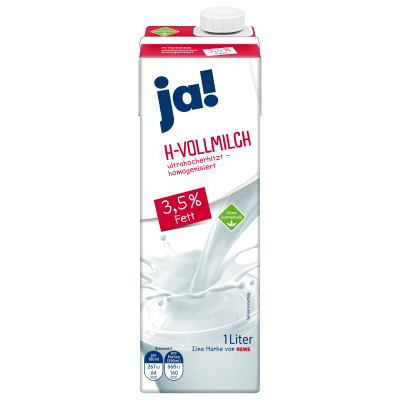
3. Dry yeast / hefe – 1 pack:

4. Flour – 4 cups:

5. Oil – 0.5 cups + 0.5 cups for frying:

6. Sugar – 2 tea-spoons:

7. Salt – 0.25 tea-spoons:

8. Optional – dry garlic powder, or rosemary, or thyme, or, dry chili flakes, any other herbs or spices you might want to flavor the naans with. I used 0.5 tea-spoons of garlic powder.
Equipment required:
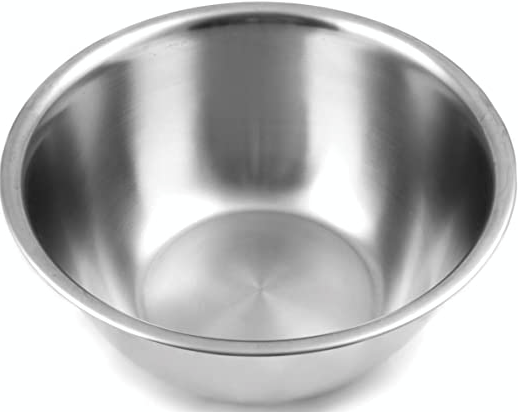
· Large bowl.
· Small towel.

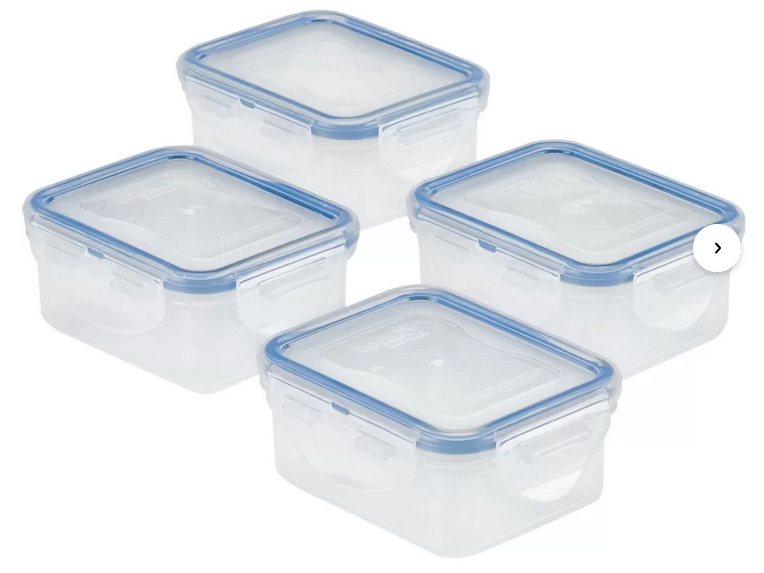
· Plastic box or tin with lid.
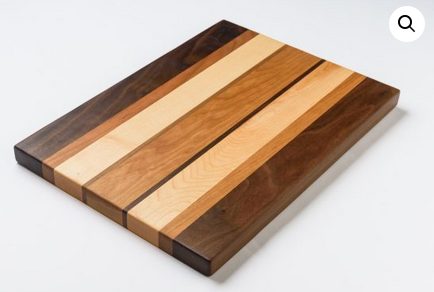
· Board.
· Rolling pin.

· Frying pan, preferably cast iron.

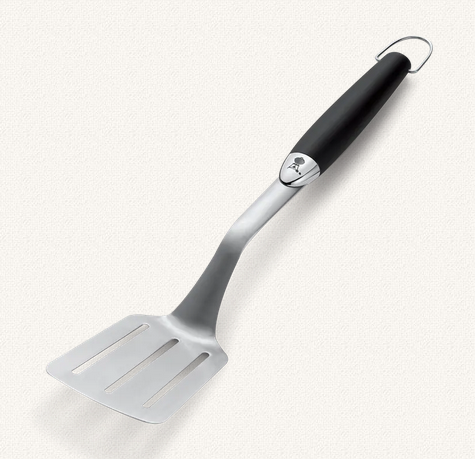
· Spatula.
· Cling film.
· Parchment paper.
· Optional: knife, big spoon, paper-kitchen-towel, etc.
Algorithm:
Part 1: making the dough:
1) In the large bowl add all the ingredients, minus 1 cup of flour.
· Use a big spoon to mix everything thoroughly.
· Add the flour from the extra cup, bit by bit.
· Knead until you have a non-sticky dough; takes 5 to 10 minutes of kneading.
· Note: there may be left-over flour, or you might need some more: accuracy = ±10%.
2) Make a large dough ball and leave it at the center of the bowl.
· Cover with the small towel.
· Put away in a warm place for 2 hours.
· Note: the dough ball should double in size.
Part 2: fortifying the dough:
3) Knead again for a few minutes.
· Until the dough is back to its original size.
· Roll into a cylindrical shape; e.g. ====
· Cut into 4 equal parts:
1st cut at the middle of the cylinder; bisect into 2 pieces; e.g. ==|==
2nd and 3rd cuts to bisect the resultant 2 pieces; e.g. =|=|=|=
3 cuts total ;-D
4) Hand-roll each of the 4 dough pieces into balls.
· Individually wrap them in cling-film:
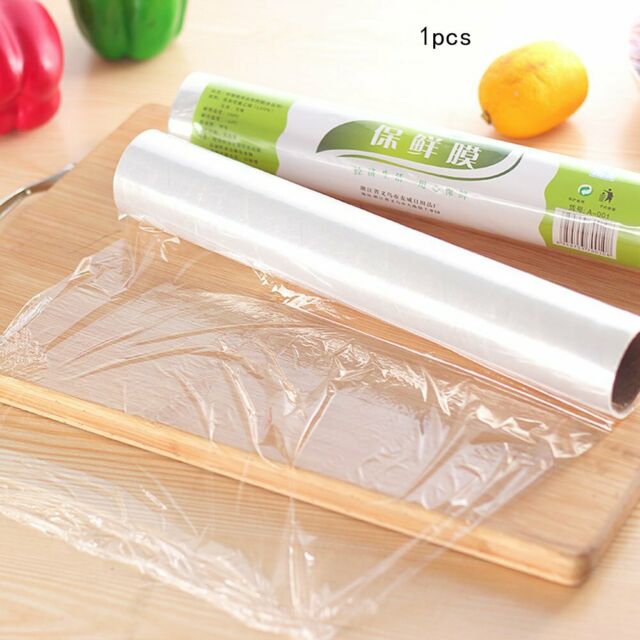
· Put them in the box, in such a way that none of the wrapped dough balls are on top of each other.
· Put the box in the freezer for 30 minutes to kill the yeast, and stop the dough from rising again.
· Take it out of the freezer.
If the dough has risen to the point of bursting the cling film, then carefully unwrap the cling film from the individual balls, and just press them down, and wrap back.
Put them back in the box.
· Put the box in the fridge and leave it there overnight.

Part 3: making the naans:
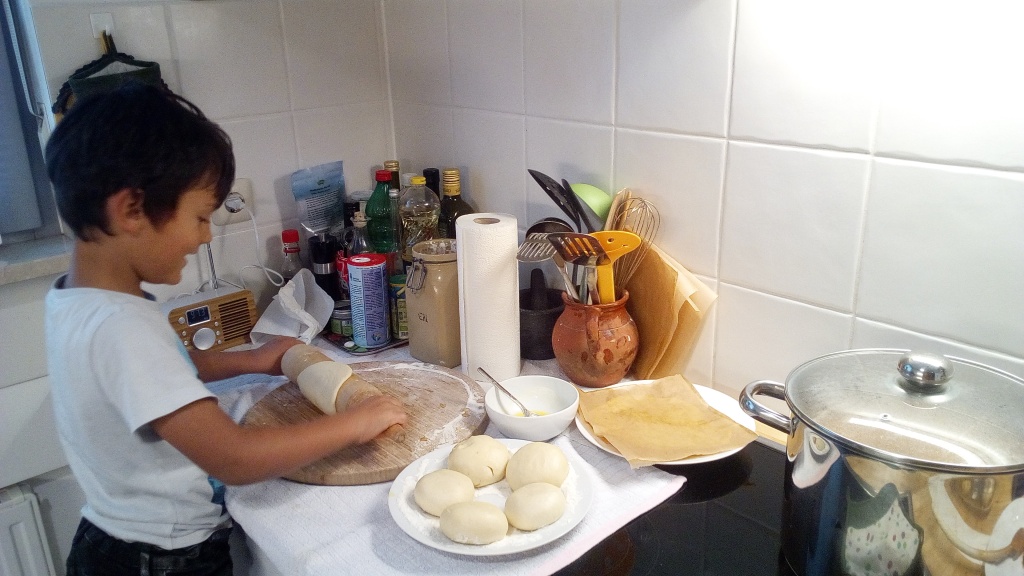
5) Use the board and rolling pin to make thick flat-breads.
· Stack them on top of each other with layers of parchment paper in between:

· Note: some extra flour will be necessary to prevent the dough from sticking to the board and rolling pin.
Part 4: frying the naans:
6) Coat the whole surface of the pan with oil.
· Do not create a lake of oil.
Put in a table spoon of oil.
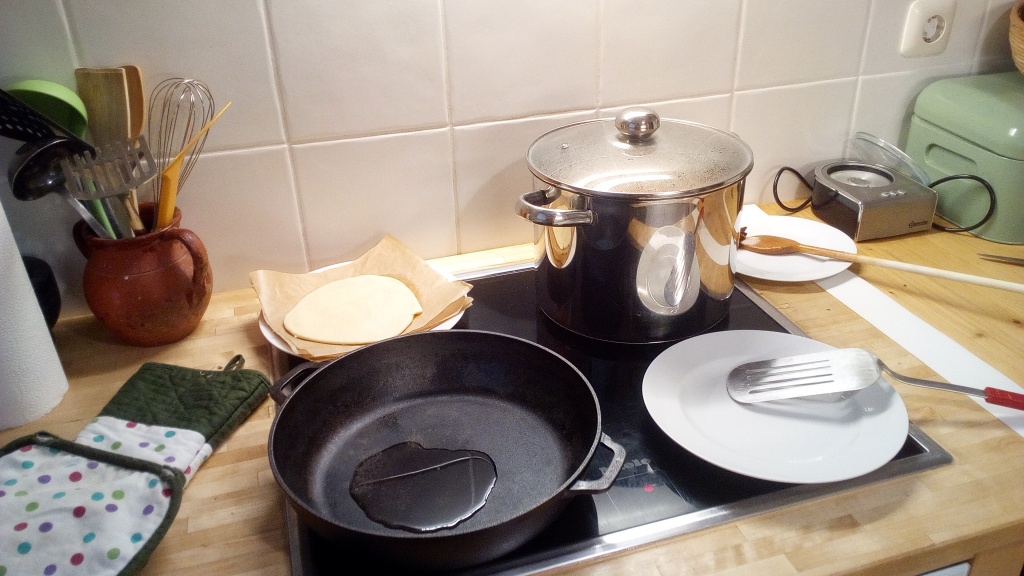
Spread across the entire surface using a spatula, or
Smear with a paper-kitchen-towel to coat the entire surface.

7) Heat the pan until the oil starts to smoke slightly; +250° C.
8) Reduce heat to ~75% power to maintain temperature.
9) Fry 1st side of a naan for ~2 minutes.
10) Flip!
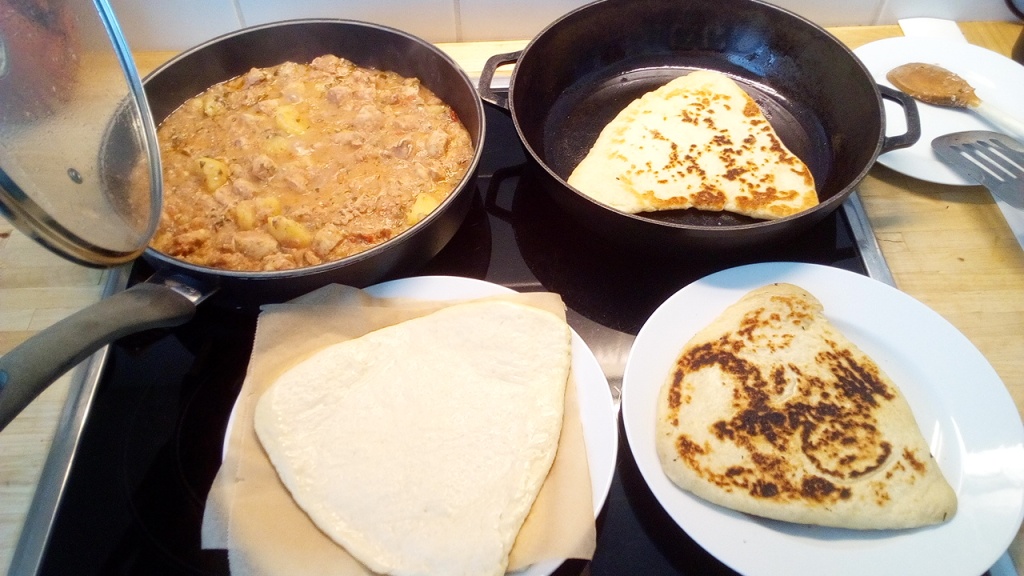
11) Fry 2nd side of the naan for another ~2 minutes:
· Press down with the spatula to assist in heat distribution and naan-puffy-fication.
12) Flip back to 1st side for ~15 seconds.
· Press down with the spatula to assist in heat distribution and naan- puffy-fication.
13) Set aside and stack on a plate for near-future consumption 🙂
14) Repeat steps 6 to 13 until all naans are done.
Naan goes well with any savory or spicy sauces and curries.
Enjoy!

I had the funniest conversation in the saddest of circumstances with my 5 year old son the other day.
We were grocery shopping at our local supermarket, my son running errands, finding the items we need from the isles, and running back to the shopping cart; my 2 year old daughter just following him around as fast as her tiny legs can carry her, sometimes picking random items and putting them into the cart.
He noticed that much of the supermarket shelves were empty, and he has the habit of asking very difficult questions; and I am not the parent that sugar-coats anything. If he asks, he gets the answer that I know is correct.
“Papa, what happens if we run out of food and can’t eat?”
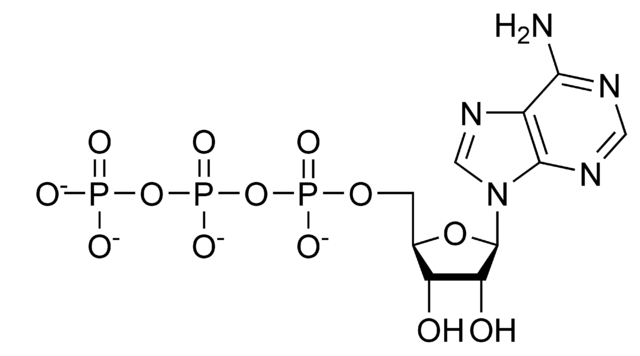
I explained to him the body’s entire energy system, oxygen usage, mitochondria, ATP, ADP, glycogen reserves, fat reserves, and muscle atrophy, etc. The whole deal, that I probably learned about during my O level biology classes.
Then I went on to explain how long each reserve can last, and why, and what effects it has on the body.
He thought for a very long minute after the monologue and concluded, “So papa, if we don’t eat, our family will die quite quickly.” then he continued, “But the fat people will survive much longer, because they have so much more fat.”
Then he asked his next difficult question, “Papa, why can’t we get fat?”
I took a deep breath, and started to explain…
Download link: Perpetual Mazes
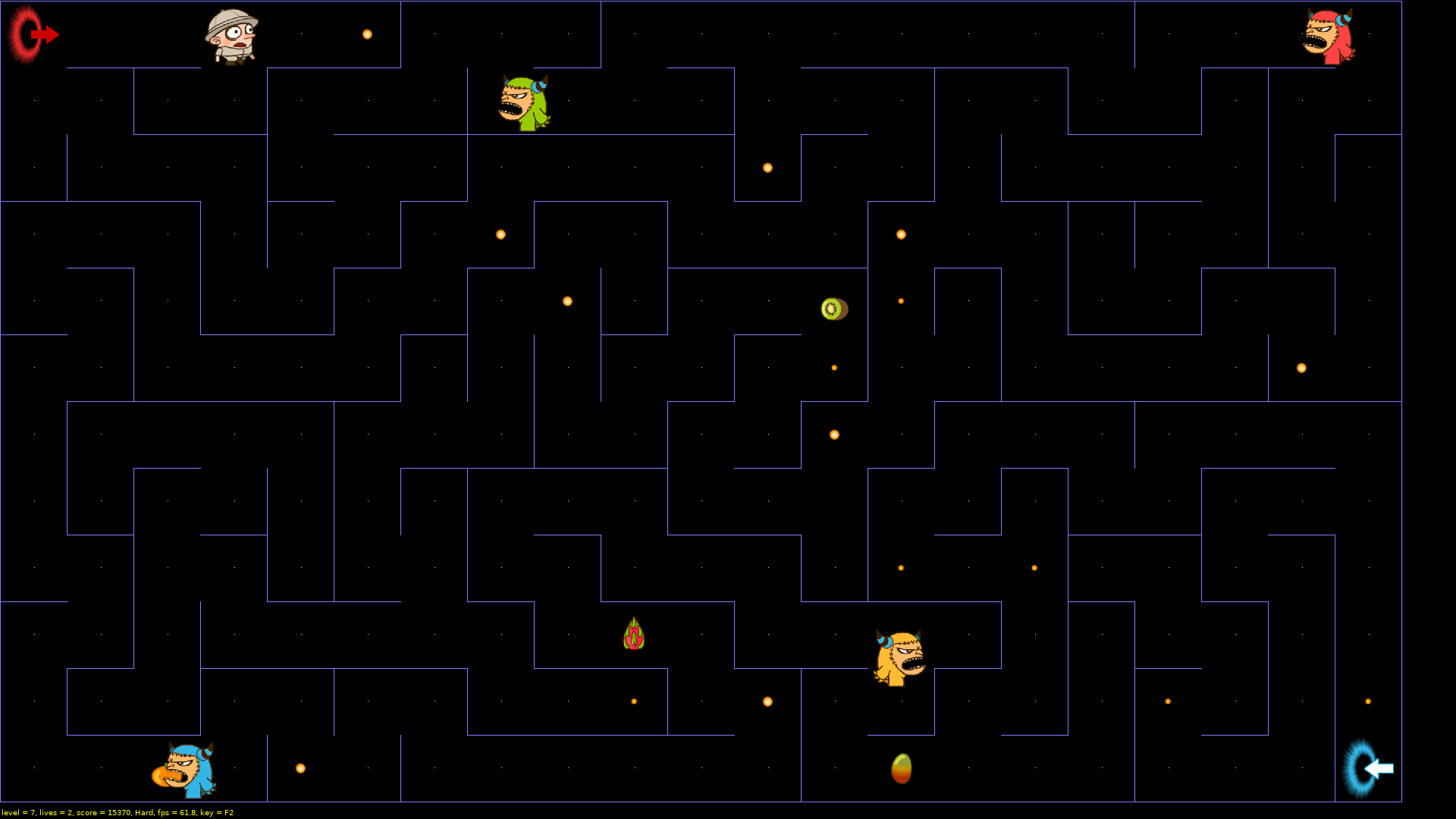
The game is a mix of Pac-Man and maze solving built with one customer’s request in mind, my 5 year old son 🙂
A little history…
Since the time my son could use a pencil, he loved to solve mazes.
Then one day at our local lounge, they have these big TV sets connected to retro game consoles, where you can just sit, chill, and play games like Pac-Man, Mario, etc.
He loved playing Pac-Man. Then one day he asked me whether there is a game like Pac-Man, that you have ghosts, and pills, and powers, but you also have to solve the maze to get out.
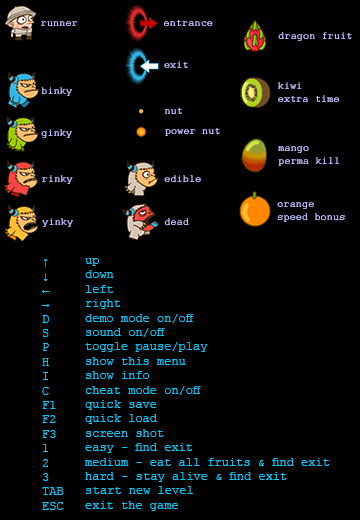
I couldn’t find one like he envisioned, so I built one, where there are monsters, and nuts, and power nuts, and fruits that give you special powers.
Download, install, and play…
The game’s only been designed to run locally on my machine, so I didn’t crease out the bugs that can occur on other machines 🙂
It’s not complete yet, in terms of the interface, and a few other things, but its playable 🙂 Just FYI: you will never get the same maze twice in your life time 🙂
Every next level the maze gets more complicated / bigger. Use your computer arrow key’s to control the “explorer”.
“Ai, Ya***n, ek cup cha nia ae to!” I could hear his voice from the other end of the street. A strong, powerful, commanding voice. He was my high-school physics teacher.
I remember sitting in his balcony, while he smoked his cigarette, and sipped his tea, discussing physics; everything but the school curriculum. We had endless discussions about reality, not in some abstract metaphorical nonsensical perspective, but in measurable expressions. Everything that was said, was demonstrable and measurable, if not, then its not physics!
We spilled water, blew bubbles, and spun things around.
We made smoke, inspected how things fly, and witnessed how invisible fluids move.
We fired lasers, measured the weight of the Earth, and the energy of the Sun.
We projected objects into orbits that intersected the Earth, and we talked about the life of stars, galaxies, and the universe.
My adolescent life in the sciences have been shaped by this man, Yameen Sir.
He was a legend.
Cheers!

This is a rehash of an old note:
Someone asked me a long time ago, “What would you like to do (or have done for you) after you’re dead?”
1) I want Liz to take care of my corpse, and aggressively exercise her right to decide what to do with it above everyone else!
2) Donate whatever is salvageable to science & research or anything else that she (Liz) thinks is a good idea, since I won’t be able to think for myself at that time, I leave it to the next best person I trust with decision making.
3) Cremate whatever is left and make sure I don’t take up any grave space.
4) Those who have my security clearance, give all access information to Liz, and explain the nature and implication of that information; bank accounts, business accounts, servers, workstations, laptops, social network, email etc… Liz: mostly up to you, what you do with them.
5) I probably won’t owe anyone anything, so everyone who owes me anything, give it to Liz.
6) Money and assets: (Liz) take half, give the rest to my parents & sister who ever are alive. Help my friends out if needed with some of your half.
7) Shup, in the mean while, has had the most wonderful time in his life while he was still alive! He died content and happy; cherished and relished every moment without regret or remorse, has lived to the fullest, has done whatever he pleased, and lead a very productive life. He has loved the people he cared about to the best of his ability, expressed it in his own peculiar way, and never looked back. He knows he will be missed by many who have out lived him, and wants them to know that if he had out lived them, he would have missed them too. And some of them he has missed all along anyway due to circumstance or the lack of an affordable teleportation machine.
8) There was no last minute conversion to some main stream religion. He died in the name of the Flying Spaghetti Monster, looking forward to respawning in his own island, with caves full of naked women, volcanoes that spew cold beer, streams of smokey whiskey, and free WiFi every where…
9) Amen: Shup has left the building!
10) People die, even the best of us, so just get over it and move on!
“You are not allowed to play with me.” my son said to his mom, while in the midst of playing a board game with me. That phrase, my son being two, to me, seemed to be too complex for him to have concocted by himself; especially since I have taken great care not to ever tell him that he is not allowed to do anything just because. For example; when he would want to use my chef’s knife, soldering iron, hot glue gun, or drilling machine, I would explain to him in the case of the knife that it is too sharp, and before he can use it he would need to learn to use his knife properly. He would understand eventually after several iterations and repetitions, and proudly declare, “When Anoosh (is) bigger, Anoosh (can) use papa’s knife.”, while happily cutting soft olives to put on the pizza we are making, with his own knife, much smaller and understandably far less sharp.
It was inevitable that groups of children would eventually say such things to him, but the realization that he had to face and deal with a rejection like that at two brought back bitter memories of my own childhood, or at least the parts that I can still remember. I was the smallest kid, youngest in class, one of the better students, and by far the most well versed in the sciences; a very bad combination in my experience. I have had to face down some version of, “You are not allowed to play with us.” more times and for more years than I care to count.
I did not know how to deal with it back then. My attitude now to such things are, “Clueless peasants!” no offence to real peasants, “Ignorant fools!” pity they are ignorant of their own ignorance, “Off with their heads!” as if that would make a difference in their intelligence.
In any case, by and large I am clueless about what to tell my son; or how to guide him on how to deal with such situations. The one thing that I don’t want is for him to emulate that kind of attitude, and eventually feel that it’s beneath him to be more inclusive and accommodating.
There is an array of things that I’ve never gotten used to, but nothing tops death and taxes. My earliest memory of someone dying was that of my grand dad, and my latest is that of an old friend, Rahin, who died today after a long battle with cancer (acute lymphoblastic leukemia). This is who he was, through my eyes…
I have known him for nearly a decade and a half, fresh out of university, and a member of my first handpicked team, that I started to call “my kids” at some point. We had a crazy time at work, pulling all-nighters to get shit done, or just to play Unreal Tournament, and later Age of Mythology, over the network. He was one hell of a gamer! Let’s put that into perspective… We were playing all against one, the one being him, and he would still win every time!
In my mind he was the soberest man I have known closely, near the other end of the spectrum that I belong to. Unlike me, he did not smoke or drink; nor did he have any crazy life threatening adrenalin junkie urges. And very much unlike me, I’ve never seen him loose his temper, get angry, or even raise his voice. He had a subtlety in himself that both fascinated me, and made me admire him.
The man was passionate and humorous, with the refinement of a seasoned artist. Who am I kidding, he was an artist!
He never made a fuss about anything in my eyes, not even his terminal illness. His way of breaking the news to me was, “I won the lottery… I think I made a mistake by not smoking and drinking :-D”
His last words to me were, “Inshallah, we shall meet again next time if I survive :-D”, by ‘next time’ he meant the next time I am back to visit Bangladesh.
Rahin, my old friend, you are still one of my kids, and I shall remember you, and miss you. I wish I didn’t have to.
Anoosh, my dearest little Noosh Noosh, you are loved, you are loved beyond how I have ever imagined I could’ve loved. You are my first and only unconditional love. You are my first and only love in perpetuity. You are my first and only love at first sight.
My life, for what its worth, is yours to use, exploit, or ignore, but where ever you are, I shall always be there for you. I was there when you were born, I was there when you walked, talked, and turned one. I shall be there when you live, love, and grow; and I shall be there when you hurt, despair, and fall. I shall laugh with you, I shall cry with you, and I shall have the sturdiest shoulders for you.
Sometimes, I may seem harsh, and at times, even cruel, but I’m all soft and mushy inside for you, and if I had made you cry, I have cried inside already.
I wish I knew what you think, and I know that soon you will tell me, and sooner still you will choose not to. In secret I hope that that day will never arrive.
I felt pride to see you walk, hear you talk, and etch your first sketch, the kind of pride probably only a father can feel. I feel proud of your achievements, more than my own, and I shall be proud of you always.
Whether you play the guitar, sing, or dance, I shall be the loudest fan to cheer for you; and as embarrassing as it might be, whether you play cricket, football, or quidditch, I shall still be the noisiest fan to cheer for you. I am your papa, I am your biggest fan, and in time I shall be everything I need to be or can.
Anoosh, my dearest little Noosh Noosh, you will forever be my little Noosh Noosh, and I shall love you always.

Last weekend, I was travelling across Germany, on the ICE, cruising at 200 kmph, while idly gazing outside as the endless fields, forests, rivers, and mountains passed by. When the monotone of the scenery outside bored me, I stared at my phone, exchanged lazy messages with loved ones near and far and watched online videos over the Wi-Fi network.
On the next stop, someone politely asked if the seat opposite to my table was empty. Without even glancing up, I told him, “Yes, it’s free.” As he stowed his backpack away, I noticed that he was a boy of may be 16 or 17 years of age. His movements looked slightly clumsy; having dodged to avoid being hit in the head by something just added to my annoyance, only to be rudely made self aware of my own prejudices when I realized that the object that I just dodged was a foldable cane. The boy was blind, travelling alone, and went about doing his thing like it was nothing.
As he took his seat, I noticed the bundle of papers he had in his hand, neatly sorted, color coded, numbered, tagged and bagged! Another glance revealed that it was a very detailed and extensive travel itinerary. I was both curious and awe struck. I took a moment to gather my thoughts, and said, “Hi…”
That was the start of a very long conversation, punctuated by the occasional monologues from me describing the scenery outside at his request. At times I would describe, the mountains passing by, with white tops, green canopies on one side, and a timeless river on the other; and immediately I would realize how futile I am at describing something to someone who’s perspective of the world does not include vision. I am vision bound, everything I do, and think about primarily relies on my vision, and I do not have a description of the world around me without vision.
Being a biologically fully functional person (color blindness doesn’t count :-P), I am not above feeling a sense of pity towards the occasional disabled person I encounter. This encounter was no different, except that within 5 minutes into the conversation, those feelings disappeared. This boy is strong, he does not need anyone’s pity, and it’s not his limitation but mine.
He had a BahnCard 100, which allows him to travel in and around Germany using any train, tram, bus, or underground network for a year without limits. I used to have one, that’s why I know how it works, but those crazy travel days are over for me now. That particular year I made over 40 round trips around the country, one almost every weekend! This boy is on a massive adventure, travelling throughout the country for an entire year. That bundle of paper is the details of where he is and will be during this adventure. It’s sorted, color coded, numbered, and tagged not for his use, but to make it easier for the less able people around him who rely solely on their vision to get anything done, such as the not-so-blind train conductors, hostel receptionists, hosts, and the random engineers sitting opposite to him.
I salute the parents who have brought him up to be the young man that he is. He was raised to believe that he has no limitations, and therefore he does not. He is doing whatever the hell he wants and doing it better than most of us can. Many people believe in a lot of hog wash, karma, life’s endless possibilities, hard-work-success, to name a few… I am too ingrained in reality to find comfort in such things, and too proud to use a crutch to sugar-coat reality. This boy had the absurdly terrible luck of being blind, but had the profoundly good fortune of being born in a country with such ridiculously good infrastructure, and coincidentally excellent parents. All of that came together to make him the person he is. I presume, very few in his shoes can say the same.
Later that evening, I was looking at recent pictures of my son, his big, beautiful eyes, and thought about the challenges the boy’s parents may have faced and cried a little. Then I considered that I have 2 variables under my control, where my son is born and raised, and what kind of parent I shall be. The first has been taken care of. The second: I shall be the parent that knows his son is perfect, beautiful, strong, intelligent, and without limits, and if anyone says otherwise to him, I shall crush their skulls with my bare hands!

 Shup's Garbage